




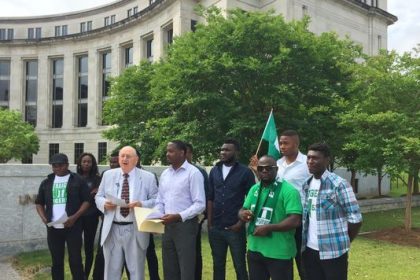
NIGER DELTA STUDENTS’ SHOCKING DISCOVERY IN AMERICA:
40 Nigerian Students Sponsored By Nigerian Govt DUPED by Alabama State University
…Vows: ‘We are taking legal steps against the varsity for STEALING our $500,000 for 3 Years’
*Says: ‘Each Nigerian Student receives $32,000 a year that covers tuition fees, health insurance’
*Regret: ‘We Don’t use all Funds, but this University keep the Excess Funds without Refund’
* Alabama State University keeps Mute, Says: ‘No Comment’
*U.S. District Judge Keith Watkins: “ASU should make at least preliminary payments on money owed to the students”
 BY GEORGE ELIJAH OTUMU/FOREIGN BUREAU CHIEF IN UNITED STATES
REPENTANT NIGERIAN MILITANTS granted amnesty earlier in Nigeria who are schooling in United States have jointly accused Alabama State University of being ‘smart-by-half’ for allegedly withholding and squandering the remains of their $32,000 annual funds paid by Nigerian Government directly to the University coffers to cover their tuition fees, health insurance and other costs.
These angry Nigerian students, 40 in numbers from Niger Delta undergoing various courses in Technology, Economics and other Information Communication program are livid that Alabama State University authorities have duped them of these funds that rightly belong to them. They had tried severally to seek a truce with the varsity management but all their please for these refunds had not yield any result.
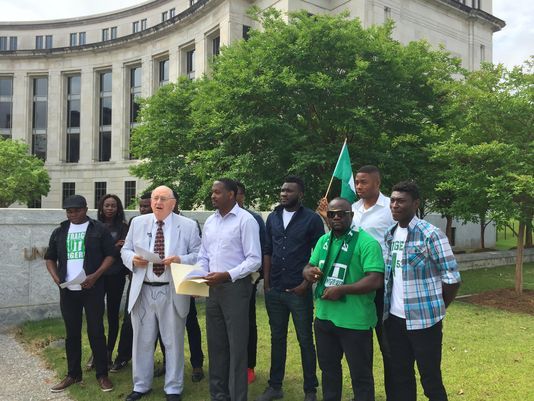
Spokesperson of the group, Kehinde Batife, one of the students explains: “When we got to the Second Semester, we were told we would be given the Scholarship form. We were assured that when we got to the Spring, we would be given this Scholarship forms that will reveal how our finances are being managed. Other students receive refunds at the end of each Semester, but we don’t receive a cent. We tried to approach ASU for that on several times, there was no profit to all our attentions. We tried hard, yet nothing is coming out of it. So we have to take it further legally than this present step.”
Not taking any further chance, these Nigerian students filed suit accusing Alabama State University, AUS, of wrongfully pocketing their scholarship money, a federal judge has declined to dismiss their claims. The complaint was brought by nearly 40 Nigerian students who the Federal Republic of Nigeria sponsored by paying their tuition, fees, health insurance and other costs.
Batife, who led the students’ efforts to reclaim their finances, said “each student is given $32,000 a year by the Nigerian government to cover their costs. Not all students use the entirety of that sum. Instead of refunding the students what they didn’t use, ASU allegedly kept any excess money. The university is also accused of putting the students’ money toward services they were not using.”
Success Jumbo, a plaintiff in the complaint, said he hasn’t lived on campus since 2014, but money continued to be taken out of his scholarship fund and put toward campus housing. His words:“I’ve suffered a lot. I got married May 2014. I’ve approached ASU on several occasions, I even took my wife and my baby to them and said, ‘Look, I no longer live on campus. I believe you guys understand the importance of being married. I need to get this money so I can use it to pay for my housing elsewhere.”
Jumbo lament he never received a refund. Other students were billed for summer tuition, although they weren’t taking summer courses.
Batife estimated that the university has withheld roughly half a million dollars from the Nigerian students over a three-year period. ASU has moved to dismiss the suit, state that the Nigerian government instructed them to withhold the students’ funds.
Confusion crept in when an anonymous Nigerian government official called ASU to “Hold on to the funds until instructions are given on the process of refunds, about a week after the complaint was filed in the court. In view of this, ASU states that it has no controversy with the Nigerian government, and the students have no grounds to challenge instructions given by an entity which funded their studies.
Though the court has preliminarily declined to dismiss the case, his opinion noted that the contract between Nigeria and ASU hasn’t been submitted for review, meaning that the case’s trajectory could shift if that contract comes to light.
After U.S. District Judge Keith Watkins issued this order, plaintiff’s attorney Julian McPhillips sent a letter to ASU’s attorney asking that ASU, “…make at least preliminary payments on money owed to the students.”
The suit also alleged that the Nigerians were the only international students who were not allowed to use their scholarship funds as they chose. Other international students were given the freedom to buy textbooks and food from providers other than university vendors. They were also allowed to put their scholarship money toward off campus housing. Nigerian students allegedly were not.
Jumbo expressed pain: “It is only the Nigerian students that were restricted. We have been put in a box. Though I graduated from ASU in May 2016, the situation is still causing unnecessary strain. When you’re paying for something, and you’re not getting what you paid for, that causes stress.”
Meanwhile, A spokesman for Alabama State declined to comment on the lawsuit, saying the university does not comment on pending litigation. An official with the Nigerian consulate in Atlanta also declined to comment.
Whatever the merits of the lawsuit, this is undoubtedly a case in which a university’s relationship with a substantial proportion of its international student population has gone sour. Thirty-seven international students, after all, are discontented enough to sue.
Alabama State, a historically black university in Montgomery, has a relatively small international student population: it enrolled just 122 international students in 2014-15, according to data held by the Institute of International Education.
The institution, which has a six-year graduation rate of 27 percent, has had accreditation troubles of late. The university’s accrediting agency, the Southern Association of Colleges and Schools, took Alabama State off warning status in June, a sanction that had been imposed two years earlier for failure to comply with requirements and standards on issues related to financial stability and control, and conflict of interest on its governing board.
The professor who recruited the group of Nigerian students to Alabama State said he now regrets it. “I feel very guilty that I brought these students to be exploited by Alabama State University,” said David Iyegha, a retired professor of geography who has served as an advocate for the Nigerian students.
“At some point I was wondering why the Nigerian government would bring us here. It’s not like this is such a fantastic school,”said Batife, one of the student plaintiffs in the case.
